
How to Build a Website with SEO in Mind
Building a new website is an exciting project. But if SEO is an afterthought, you could find yourself spending time and budget fixing problems that should have been avoided from the start.
Written by: Amber, SEO Manager
15/06/2026
4 min read

An SEO friendly website is not just about ticking a few technical boxes before launch. It is about making considered decisions throughout the planning and build process, so that search engines can understand and rank your site and users actually enjoy spending time on it.
Whether you are building from scratch or migrating from an existing site, here are the key SEO considerations when building a website.
Start with Keyword Research
Before a single page is built or a single word of copy is written, you need to know what your potential customers are actually searching for. Keyword research is the foundation of any SEO ready website, because it shapes everything from your site structure and page topics to the language you use throughout your content.
Start by identifying the terms and phrases that are most relevant to your products or services, and look at search volume, competition and intent. Are people looking to buy, to compare, or to learn? Understanding intent helps you match the right content to the right audience at the right stage of their journey.
The research you do at this stage also helps you avoid duplicating content across pages, which is a common issue on sites that are built without any strategic planning. If two pages are targeting the same search terms, they end up competing with each other rather than strengthening your overall visibility.
Get Your URL Structure Right from the Beginning
URLs might seem like a minor detail, but they matter more than most people realise. A clear, logical URL structure helps search engines crawl and understand your site, whilst making it easier for users to navigate and share pages.
Good URLs are descriptive, short where possible and reflect the hierarchy of your site. For example, a URL like /services/web-design/ tells both Google and your visitor exactly where they are and how that page fits into the wider site. Avoid using unnecessary parameters, numbers or session IDs in URLs and use hyphens rather than underscores to separate words.
It is much easier to get this right at the build stage than to change URLs later. Changing URLs on a live site requires careful redirect management to avoid losing traffic and rankings, which is why planning your URL structure before development begins is time well spent.
Plan Your Site Hierarchy and Menu Structure
How your site is structured has a direct impact on both user experience and SEO. A well-thought-out hierarchy makes it easy for search engines to crawl every page and understand how your content is connected. It also helps users find what they are looking for quickly, without having to dig through multiple layers of navigation.
As a general rule, important pages should be no more than a few clicks from the homepage. Your navigation menu should reflect the most commercially valuable areas of your site. The structure should mirror the way your customers think about your products or services, rather than the way your business is internally organised.
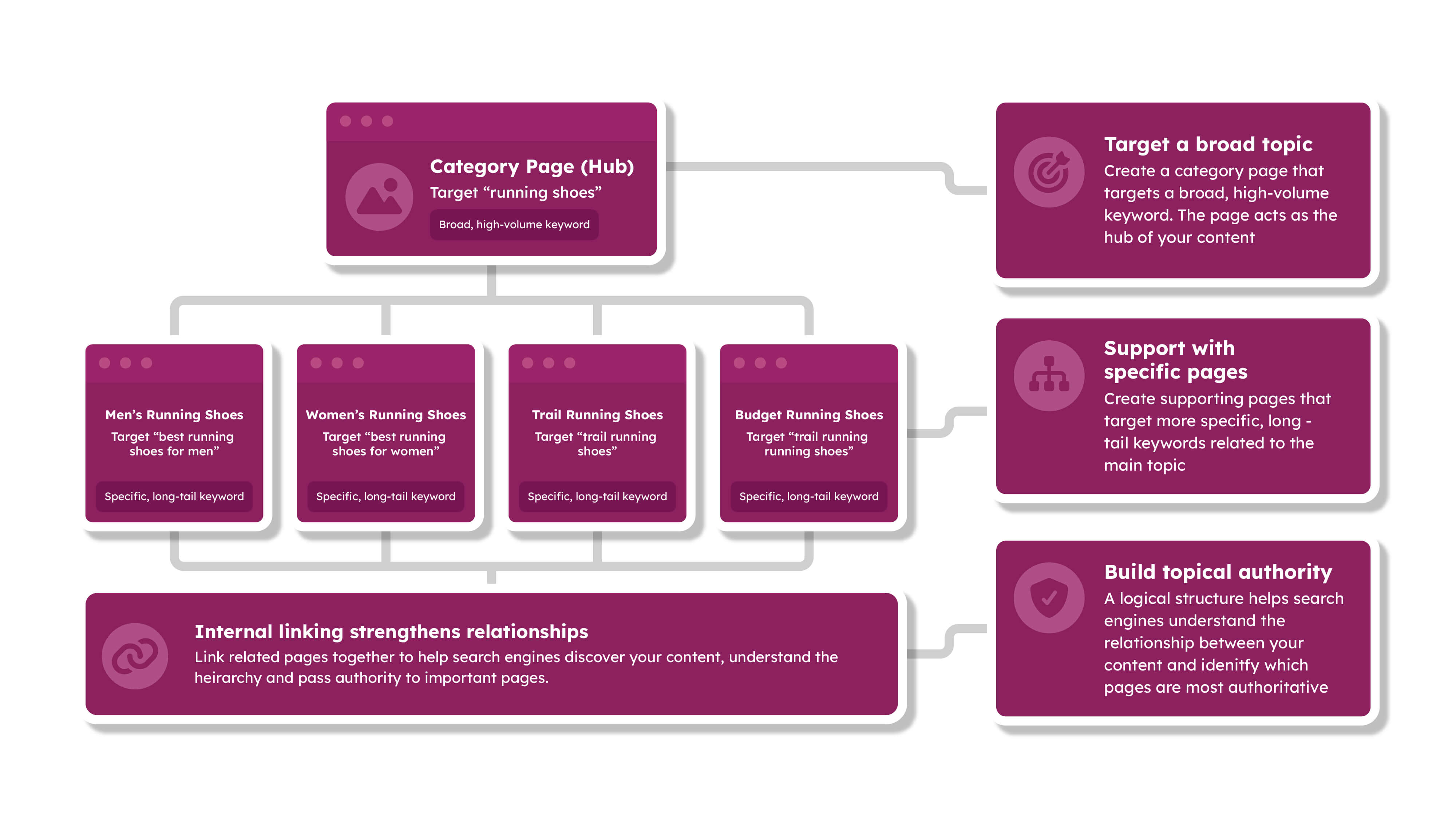
Think about which pages you want to rank and build your structure around supporting them. For example, a category page targeting a broad term can act as a hub, with supporting pages targeting more specific queries underneath it. This kind of logical grouping helps search engines understand the relationship between your content and assess which pages should be seen as authoritative.
User Experience is an SEO Signal
SEO friendly website design is not purely technical. The way your site looks and behaves matters to search engines because it matters to users. Google has made it increasingly clear that pages which offer a poor experience are less likely to rank well, regardless of how well they are optimised in other areas.
This covers several things. Page speed is one of the most important factors. A slow site leads to high bounce rates and low engagement, neither of which helps your rankings. Mobile responsiveness is equally critical given that the majority of searches now happen on mobile devices. Google indexes the mobile version of your site first, so if your mobile experience is poor, your rankings will suffer.
Core Web Vitals are a set of specific metrics Google uses to measure user experience, covering load time, interactivity and visual stability. These are worth building around from the start rather than trying to fix retrospectively once the site has launched. Your developer should be aware of these benchmarks and design with them in mind.
Clear calls to action, readable typography, logical page layouts and accessible design all contribute to a better experience. A better experience generally means more time on site and more conversions. Good SEO and good UX are far more aligned than people often expect.
Lay the Right Technical Foundations
A search engine friendly website needs to be technically sound. There are several things that should be in place before your site goes live, most of which are far easier to address during the build than after launch:
- Your site should be served over HTTPS. This has been a ranking factor for some time now and is also a basic trust signal for users.
- An XML sitemap should be created and submitted to Google Search Console so search engines know which pages you want to be crawled and indexed.
- A robots.txt file should be in place to prevent search engines from accessing pages that do not need to be indexed, such as admin areas or duplicate content.
- Structured data, sometimes called schema markup, is worth considering at the build stage too. It allows you to provide search engines with additional context about your content, which can result in enhanced search results such as star ratings, FAQs or event details appearing directly in the search listings.
- Canonical tags are another important consideration, particularly for e-commerce sites where the same product might appear under multiple categories or with different filter parameters. Setting canonicals correctly from the start prevents duplicate content issues from accumulating over time.
On-Page Optimisation Should be Built In, Not Bolted On
Every page on your site should have a clear purpose and should target a specific topic or set of related search terms. When it comes to making a website SEO friendly, on-page elements matter a great deal. Title tags, meta descriptions, heading structures and image alt text all play a role in how search engines interpret and rank your content.
Title tags should be unique to each page, descriptive and ideally include your target keyword. Meta descriptions do not directly influence rankings but they do affect click-through rates, so it is worth writing them carefully. Your heading structure should reflect the content hierarchy of the page, with one H1 per page and supporting H2s and H3s that make it easy to scan.
The copy itself should be written for users first, but with your target keywords woven in naturally. Keyword stuffing is counterproductive and tends to produce copy that reads badly, which puts people off and signals to Google that the page is not particularly useful. Write clearly and informatively, cover the topic thoroughly, and the SEO benefits follow.
If You Are Moving from an Existing Site, Plan Your Migration Carefully
If you already have a website, a redesign or rebuild can inadvertently undo a lot of the SEO progress you have made. A site migration done without proper planning is one of the most common causes of significant drops in organic traffic, and in some cases those drops can take months to recover from.
Before the new site goes live, you should carry out a full crawl of the existing site and identify every URL that is currently indexed or receiving traffic. Any URL that is changing needs a 301 redirect pointing from the old address to the equivalent new one. If pages are being removed entirely, you need to decide whether to redirect them to the most relevant alternative or consolidate the content elsewhere.
It is also worth preserving any on-page SEO work that is currently in place. Title tags, heading structures and optimised copy that have been earning rankings should carry across to the new site. Update and improve where necessary, rather than replacing everything with generic placeholder content.
Once the new site is live, submit your updated sitemap to Google Search Console, monitor crawl errors and watch your rankings closely during the weeks that follow. Some fluctuation is normal, but a well-managed migration should not produce dramatic or sustained drops.
Think Beyond Launch with a Content Strategy
An SEO optimised website is not a one-time job. The sites that perform best in search over the long term are those that continue to produce useful, relevant content on a consistent basis. A blog or knowledge hub gives you the opportunity to target a wider range of search terms, answer questions your customers are asking and demonstrate expertise in your field.
Planning your content strategy at the build stage means you can design the site to accommodate it from the outset, including the right category structures, internal linking pathways and template designs for blog posts or resource pages. Trying to retrofit a content strategy onto a site that was not built with it in mind often leads to structural compromises.
Internal linking is particularly important here. Every piece of content you publish should connect to relevant pages elsewhere on the site, passing authority through and guiding users towards the pages that matter most commercially. A well-linked site is easier for search engines to crawl and easier for users to navigate.
Getting It Right from the Start
The decisions you make during the planning and build phase of a website have a lasting impact on how well it performs in search. SEO friendly website development is not about adding a plugin and hoping for the best. It is about making informed choices at every stage, from your URL structure and site architecture through to your content, your technical setup and your user experience.
At Northern Media, we work with businesses across a range of sectors to build websites that are designed with SEO in mind from day one. If you are planning a new site or considering a rebuild and want to make sure your investment delivers results in search, get in touch with our team.
